

When Is Sign Repair Worth It Instead of Replacement?
Sign repair is usually worth it when the structure and mounting are sound, the problem is limited and the existing design still serves your business. Replacement becomes the stronger option when safety issues, repeated failures or an outdated message make another fix a short-term expense.
The decision should not depend on age or price alone. A faded face on a solid cabinet presents a different problem from corroded supports hidden behind an attractive exterior. Before approving either option, determine what failed, what can safely stay and how much useful service the investment is likely to provide.
Address immediate safety hazards first
A loose panel, leaning support, exposed wiring or burning smell changes the priority from budgeting to protecting people. Keep customers and employees away from the affected area. Do not climb, open an electrical enclosure or attempt to secure a damaged sign yourself.
If power can be shut off using a clearly identified disconnect that is safely accessible away from the damage, do so. Otherwise, leave it alone and call a qualified professional. Contact emergency services if there is fire, active arcing or an immediate threat to people.
OSHA’s guidance on electrical hazards explains why electrical work requires appropriate precautions and qualified personnel. A dark sign is not proof that its components are de-energized.
For a damaged or unstable installation, a sign repair estimate should follow immediate hazard control. Ask the contractor whether the sign needs to remain off, whether the area needs to stay restricted and whether a structural assessment is necessary.
When sign repair is worth the investment
Repair is a strong candidate when the failure has a clear cause and the surrounding materials remain serviceable. An isolated failed power supply, damaged face or loose connection does not automatically justify replacing an entire installation.
The sign should also still do its job: identify the business, remain readable from the intended approach and display current branding. Restoring illumination will not solve lettering that drivers cannot read.
Different sign types require different evaluations:
| Sign type | Problems that may be repairable | What could favor replacement |
|---|---|---|
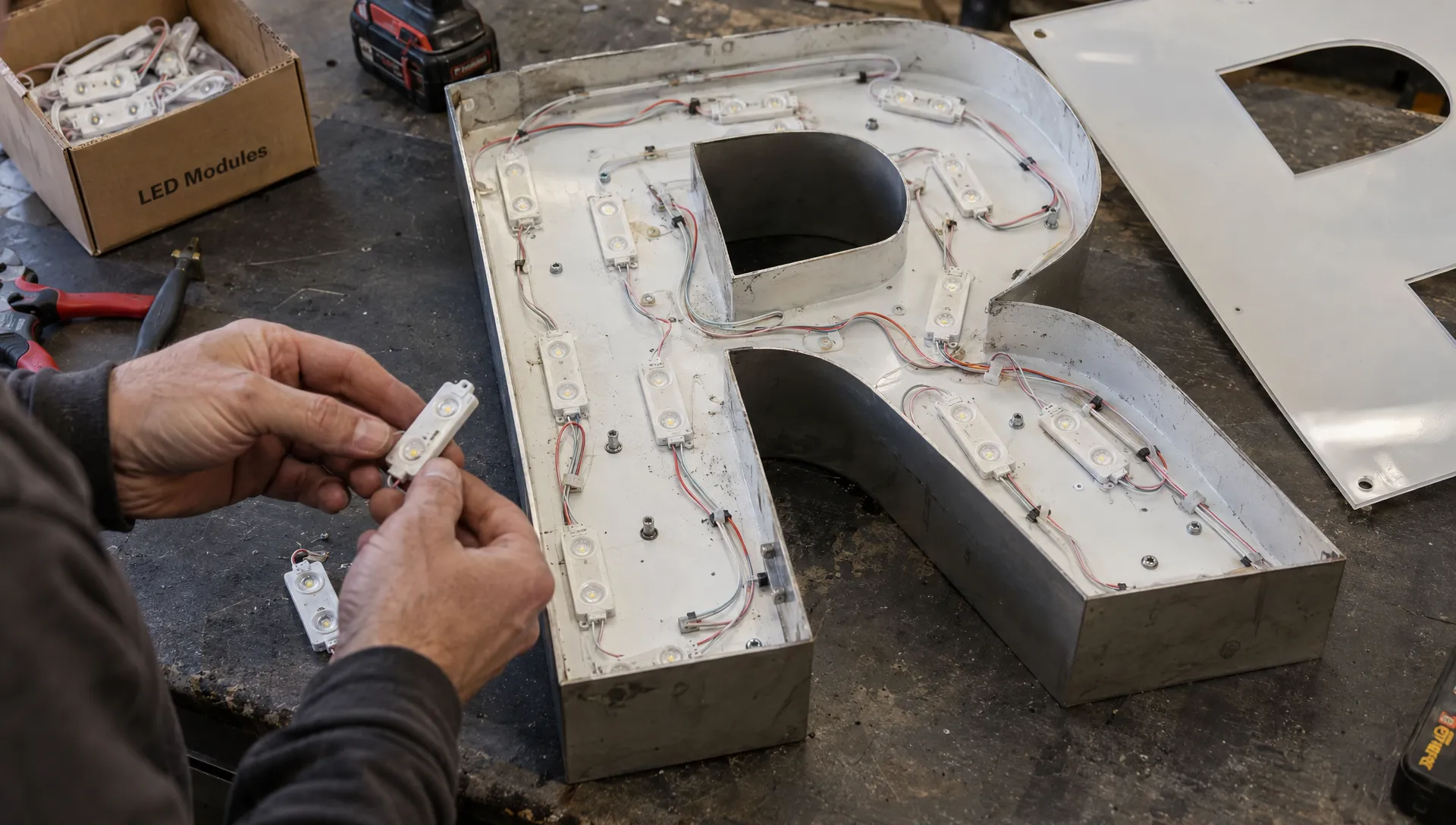
| Illuminated cabinets and channel letters | Failed LED modules, power supplies or individual faces | Widespread deterioration, recurring water intrusion or damaged housings |
| Neon signs | Broken tubing or failed electrical components | Extensive damage, unavailable parts or operating needs better served by another system |
| Monument and pylon signs | Damaged panels, lettering or lighting | Compromised supports, foundations or attachment points |
| Digital LED displays | Individual modules, power components or controls | Unsupported proprietary parts or multiple aging systems |
| Non-illuminated panels and letters | Localized graphic damage or individual letters | Brittle panels, extensive delamination or weakened backing |
These are assessment categories, not diagnoses. A good sign repair proposal identifies both the failed component and the underlying cause, rather than simply replacing whatever stopped working.
Consider refacing or retrofitting before replacing everything
The choice is not always between a small fix and a completely new sign. Refacing replaces the visible face or graphics while retaining suitable existing components. Retrofitting updates a system, such as converting compatible illumination to LEDs.
For an illuminated cabinet, a new face may restore appearance without discarding a sound enclosure. Options such as pan-faced sign faces are worth discussing when the cabinet’s dimensions, condition and attachment system support them.
An LED conversion also requires more than swapping light sources. The contractor should evaluate power compatibility, illumination uniformity, ventilation and applicable electrical or listing requirements. Keeping the cabinet only saves money if it remains a dependable part of the finished installation.
Compare the full cost, not just the first quote
A low parts price can hide expensive access or installation work. An elevated sign may require a lift, traffic control or multiple visits. Those costs matter whether you repair or replace it.
The true cost of sign repair includes diagnosis, safe access, corrective work and any related work needed to prevent the same failure. Ask for an itemized scope covering:
- Diagnosis and cause: What failed, what was tested and what remains uncertain.
- Parts and labor: Which components will be replaced and which will remain.
- Access and site work: Lift rental, access arrangements, removal and disposal where applicable.
- Approvals: Any permit, inspection or engineering responsibilities.
- Warranty: Coverage for parts, workmanship and return visits.
Compare quotes with equivalent scopes. One contractor may address a leaking enclosure while another prices only a replacement power supply. The cheaper quote may leave the original cause untouched.
Also consider downtime. A durable repair that restores visibility quickly can be valuable, but repeated outages can erase that advantage through additional service calls and periods when customers struggle to find you.
Estimate the cost per useful year
Ask how much additional service each option is reasonably expected to provide, based on the inspected condition and proposed materials. Treat that estimate as a planning assumption, not a warranty.
For illustration only, suppose an all-in repair costs $1,500 and is expected to provide three additional years of service. A $6,000 replacement expected to provide 12 years also works out to $500 per year. These are hypothetical figures, not market prices or lifespan promises.
That simple comparison excludes financing, energy use and future maintenance, but it shows why the lowest upfront expense is not automatically the better value. Sign repair is more attractive when the retained components are likely to remain reliable, not merely when the immediate bill is smaller.
Review previous invoices as well. Several visits for unrelated failures can indicate broader deterioration, even if each individual fix seems affordable.
When replacement offers better value
Replacement deserves serious consideration when a qualified assessment finds widespread corrosion, compromised mounting, extensive material breakdown or several failing systems. Covering damaged areas with new graphics does not restore structural integrity.
Repeated failures also matter. Before approving another service call, ask whether the contractor expects to address a root cause or simply restore operation until another aging component fails. There is no universal rule that a repair above a certain percentage of replacement cost is automatically a bad investment.
Sign repair also loses value when the sign no longer fits the business. A new name, different tenant layout or poor visibility may justify a new design even if the existing sign can technically be fixed. Evaluate those needs using the same practical criteria involved in choosing custom signage for your brand.
For retailers selling branded merchandise, a logo change may also affect custom woven labels and patches, packaging and other physical brand materials. Coordinate those updates with the storefront rather than paying to restore artwork you already intend to retire.
Gather useful information before requesting an estimate
Clear information helps a contractor distinguish a likely component failure from a larger project. Take photos from ground level and safe public or authorized areas. Do not climb or remove covers to improve the view.
Before requesting a sign repair quote, gather:
- Wide photos: The entire sign, its building or support structure and the surrounding access area.
- Detail photos: Visible cracks, missing pieces, staining or dark sections, photographed from a safe position.
- Day and night views: These help distinguish appearance problems from illumination failures.
- Failure history: When the issue began, whether it is intermittent and whether it followed a storm or other event.
- Existing records: Approximate installation date, previous invoices, available drawings and warranty documents.
- Property details: Site address, landlord requirements, business hours and access restrictions.
Describe symptoms precisely. “The left three letters flicker after rain” gives a contractor more useful information than “the sign is broken.” An initial photo review may help establish the next step, but concealed wiring, corrosion and mounting conditions can still require an on-site inspection.
Check the provider’s scope, credentials and warranty
Confirm that the provider works on your sign type and can handle its height and access conditions. Neon, digital displays and large freestanding structures may require different specialists.
Ask about licensing required for the proposed work, current liability insurance and workers’ compensation coverage where applicable. If electrical or structural work will be subcontracted, clarify who performs it and who is responsible for coordinating the project.
A written sign repair scope should distinguish confirmed work from possible additional work discovered after opening the sign. Require approval before costs expand beyond the agreed amount, and ask whether diagnostic charges apply toward the project.
Warranty terms should identify the covered components, workmanship period, exclusions and responsibility for access costs during a return visit. A parts warranty may not pay for labor or a lift.
Local approvals need attention too. Requirements can differ for maintenance, electrical modifications, refacing and complete replacement. Ask the local sign or building department before assuming an existing installation is exempt. Changes to a legally nonconforming sign may affect its status, so confirm the rules before removal or alteration.
Use maintenance to protect the investment
After corrective work, request a maintenance plan suited to the materials, exposure and installation. There is no single inspection interval that fits every storefront, roadside sign or coastal location.
A useful plan may include manufacturer-approved cleaning, checks of accessible seals and drainage paths, inspection of electrical enclosures and professional review of fasteners and supports. Property staff can document visible changes from the ground without opening the sign.
Prompt attention to flickering, staining, new gaps or loose-looking faces can keep a manageable issue from becoming more disruptive. After severe weather, check for visible movement or damage from a safe distance and report concerns promptly.
Keep invoices, photographs and component details together. That history makes the next sign repair decision easier: you can see whether the installation has been dependable or whether service calls are becoming a pattern. It also helps a future contractor avoid repeating unsuccessful work.
Frequently asked questions
How old is too old to repair a sign? There is no universal cutoff. Material condition, mounting integrity, exposure, parts availability and repair history matter more than age alone. An older cabinet in sound condition may justify investment, while a newer installation with serious corrosion may not.
Can LED and neon signs both be repaired? Often, yes. LED signs may need modules, power supplies or other components replaced. Neon can require tubing or electrical work by a specialist. The decision depends on the extent of damage, available parts and condition of the remaining system.
Does sign repair require a permit? Sometimes. Local rules and the scope of work determine the answer. Routine maintenance may be treated differently from electrical changes, structural alterations or replacement. Confirm requirements with the appropriate local department and clarify who handles approvals in the contract.
Should I replace every light when one section goes dark? Not automatically. A dark section could result from an isolated component or a shared power issue. Have the cause diagnosed first. Replacing a broader group of components may be sensible when deterioration is widespread or repeated access would be costly, but that recommendation should be explained in the quote.
Choose the next step based on condition
Before authorizing work, request three clear answers: what failed, what can safely remain and what the proposed investment is expected to accomplish.
If replacement is the better choice, contact Showstopper Signs to discuss custom commercial signage. The team works with businesses from design and consultation through fabrication and installation. Bring your existing sign photos, inspection findings and visibility goals so the replacement addresses more than the original fault.